Editing Aloud
Why I've started inviting my kids to eavesdrop as I work

A few weeks ago, I had an impossible task: cutting an essay in half for a public reading. Of course this was necessary—no one wanted to hear me read for 30 minutes. It was also hard! I had left this til the last minute, and of course the reading was on a Saturday, so the children were everywhere and baffled that I was working instead of hanging out.

My middle one came and sat next to me on the bed. Watched as I cut a sentence. Furrowed her brow as I restructured the next sentence to fit. “Delete that one?” she asked, gesturing to a place on the page. And I realized that it looked, to her, like I was making choices at random. The very boisterous conversation that I was having in my head was invisible to her. So what was different, really, than having a machine do the edits, besides that I was, on the outside, slower?
A few days later, she came in when I was editing a book. Usually the rule is that they can stay with me if they can quietly read, but this time I asked if she wanted to watch. I ran spell check. I pointed out places that the machine was wrong “look! It doesn’t know these are names! Let’s ignore those.” Places where we ignored spell check’s suggestions because of the author’s intent: “Look—he wanted to use that word twice here, so we’re going to ignore that.” And then we left a few comments (which I let her type, and I lightly edited) asking questions about meaning. I pointed out a few sentences I loved, and then she scampered away.
~~~~
One of my favorite books is Lifespan of a Fact (which I just learned got turned into a play! How cool is that!) by Jim Fingal and John D’Agata, which asks the question: how negotiable is a fact? And contains the results of seven years of back-and-forth between an author and a fact checker over the nature of truth in literary non-fiction.
The book imprinted on my mind because of how fraught and human the fact checking process is, and because of the author’s insistence that certain “facts” obscured larger truths to the story.
I’ve realized that I badly want to teach my kids, and my writers, that the “facts” of language can obscure larger truths about writing. I want them to realize that rejecting the machine’s suggestions is absolutely critical to preserving their own voice and persona as a writer. How do we model thought processes aloud in a way that makes it clear that thinking is hard, and good?
~~~~
We know, because cognitive scientists have started documenting it, that we’re entering a period of languge—and thought—homogenization:
“Cognitive diversity, reflected in variations of language, perspective, and reasoning, is essential to creativity and collective intelligence. This diversity is rich and grounded in culture, history, and individual experience. Yet, as large language models (LLMs) become deeply embedded in people’s lives, they risk standardizing language and reasoning. We synthesize evidence across linguistics, psychology, cognitive science, and computer science to show how LLMs reflect and reinforce dominant styles while marginalizing alternative voices and reasoning strategies. We examine how their design and widespread use contribute to this effect by mirroring patterns in their training data and amplifying convergence as all people increasingly rely on the same models across contexts. Unchecked, this homogenization risks flattening the cognitive landscapes that drive collective intelligence and adaptability.”
~~~~
I was talking to someone the other day who remembers getting a C her first year of law school because the content was perfect in her semester-end brief, but she lost a point for each typo—and she’d been up all night getting the case law right, and so didn’t have time to proofread.
I know attention to detail matters, but I also wonder what the cost is of those policies. How does it teach thinking, instead of compliance?
~~~~
My sense is that we prevent against some of this by trying to recover a materiality to the writing process. What does it mean to teach kids to write and edit as an art, not as a utilitarian skill to obtain? I have a client who is working through some structural questions—my advice to her was to print out the different pieces, cut them up, and then play different games rearranging them. What does it look like chronologically? What does it look like thematically? With a thematic organization, which pile of scenes is thick, which scenes or passages becomes orphans? Another client is trying to write about ethnographic research. To write ethnography, you have to read ethnography. Study the craft. Slow down some.
~~~~
Last night, my daughter came in again and did the same thing: “let’s edit together!” and for five minutes, we did. We discovered she has a strong aversion to footnotes, prefers endnotes, and then we turned to a musical she’s working on about a loitering cat in a box (not Schrödinger—wrong cat). And today I talked to a high school journalism student today and she was so excited about writing a story about how the cell phone ban in NYC schools means that kids are playing hacky-sack and doing word searches at lunch. And then I talked to one of my clients who has an amazing story, and I was able to say “YES. Tell this story.” And somehow, these conversations—an 8-year-old, a 17-year-old, a 30-something-year-old—are all echoes of how we do this writing because there’s something exciting about it! About finding a story, wanting to share it, capturing it in cool ways, and then sharing with the world. That’s why we do this. And that’s why it’s worth protecting your right to think, your right to write imperfectly and messily and loudly. To read things with typos in them.
xoxo
Kelly
Here is the schedule of courses and workshops—no payment is due when you register, just an indication of interest so we can find times that work for everyone. Please share these widely!! Send me good people!!
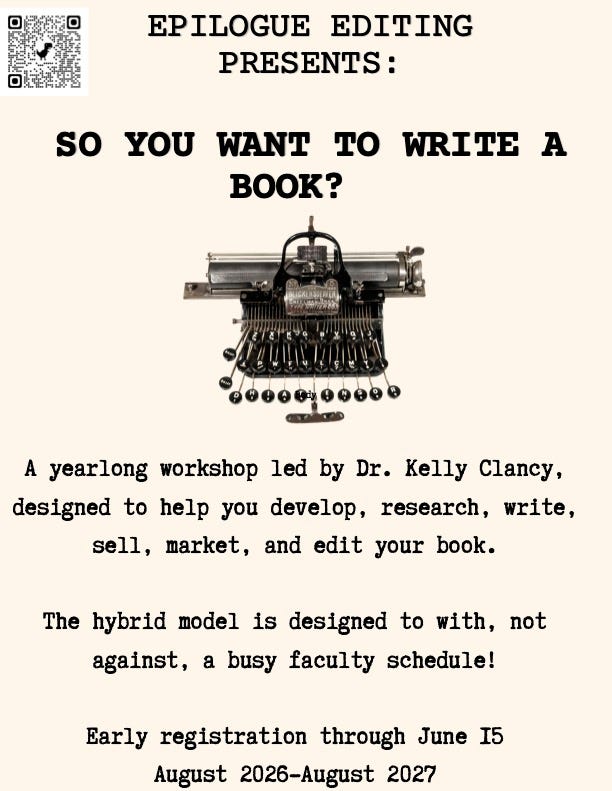
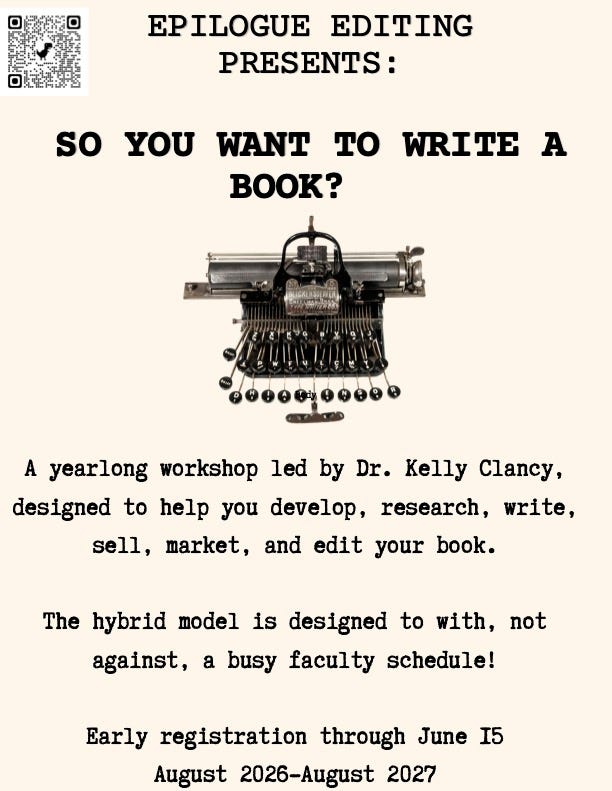
So You Want to Write A Book? August 2026-May 2027
A unique hybrid workshop dedicated to supporting writers throughout their book writing journey. Start with a new cohort in August. Note: these were originally scheduled to begin in May, but we shifted to August to accommodate participants and the school year.
Details here, Register here, early bird rate available by June 15.
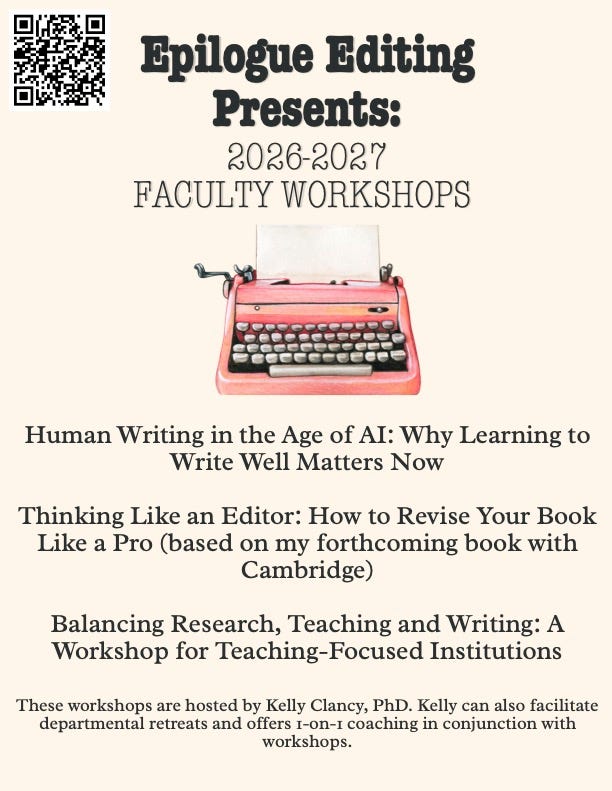
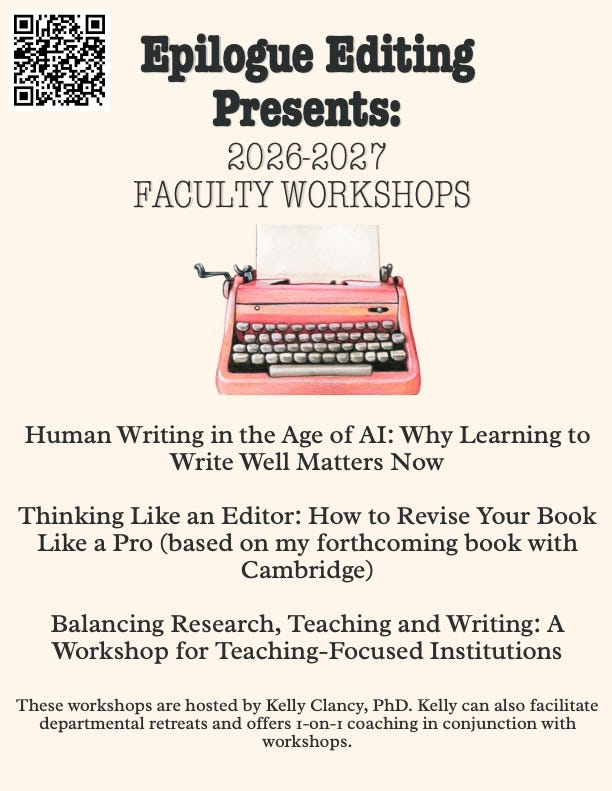
Departmental workshops and retreats: I’m currently scheduling workshops for the fall of 2026 and the spring of 2027. Reach out to talk about designing a workshop or series of coaching sessions based on what your community needs—including how to preserve human writing in the age of AI.
Coming soon: Fall writers’ circles! Registration opens in June, circles begin in September
People sometimes ask if there is a way to pre-register for things in order to use research funds that expire at the end of the fiscal year. Let’s set up a meeting and chat!
Your passion for writing and editing comes through in this piece, and I LOVE that you got a kiddo excited about it too! This gave me lots to think about as I've been puzzling through the challenges presented by AI all year long. The homogenization of writing and thinking is truly troubling.